

Singapore’s S Pass serves as the essential mid-skilled work pass for foreign professionals in technical, operational, and supervisory roles. With S Pass applications becoming increasingly competitive, understanding the latest S Pass requirement updates is crucial for both employers and candidates today to get ahead. Navigating the 2025 business landscape can be challenging – and RMI is here to help.
The Ministry of Manpower (MOM) has implemented significant changes to S-Pass salary 2025 thresholds, tightened S Pass eligibility Singapore criteria, and enhanced verification standards. For employers managing their Singapore work pass salary budgets, these updates require careful planning around quota limitations and levy obligations.
This comprehensive guide covers everything you need to know about S Pass minimum salary requirements, the S Pass application process, and strategies for successful submissions. Whether you’re an employer seeking new talent or a candidate evaluating potential opportunities, these insights will help you navigate the updated S Pass requirements effectively and set you up for success.
What is the S Pass, and who is it for?
The S Pass functions as Singapore’s primary mid-skilled work pass, bridging the gap between basic Work Permits and senior-level Employment Passes. It’s specifically designed for foreign professionals who bring technical expertise, supervisory capabilities, or specialised skills that complement Singapore’s workforce development goals.
Unlike higher-tier work passes, S Pass eligibility Singapore focuses on practical competence rather than academic credentials alone. The roles typically include technicians, team leaders, quality control specialists, project coordinators, and skilled trades professionals who require formal qualifications but operate in hands-on environments.
The S Pass Singapore framework sits strategically between the Employment Pass for management-level professionals and Work Permits for basic skilled roles. This positioning makes it essential for companies hiring mid-level technical talent, especially in manufacturing, construction, marine, and process industries where specialised skills often face local shortages.
Key eligibility factors include competitive Singapore work pass salary offers, verifiable qualifications relevant to the role, demonstrated experience in similar positions, and employer compliance with quota and levy requirements that regulate foreign workforce composition.
S Pass minimum salary requirements
The S Pass minimum salary thresholds have increased significantly for 2025, reflecting Singapore’s commitment to ensuring foreign workers contribute meaningfully to the economy. Understanding these S Pass salary 2025 requirements is essential for both employers and candidates planning applications in the near future.
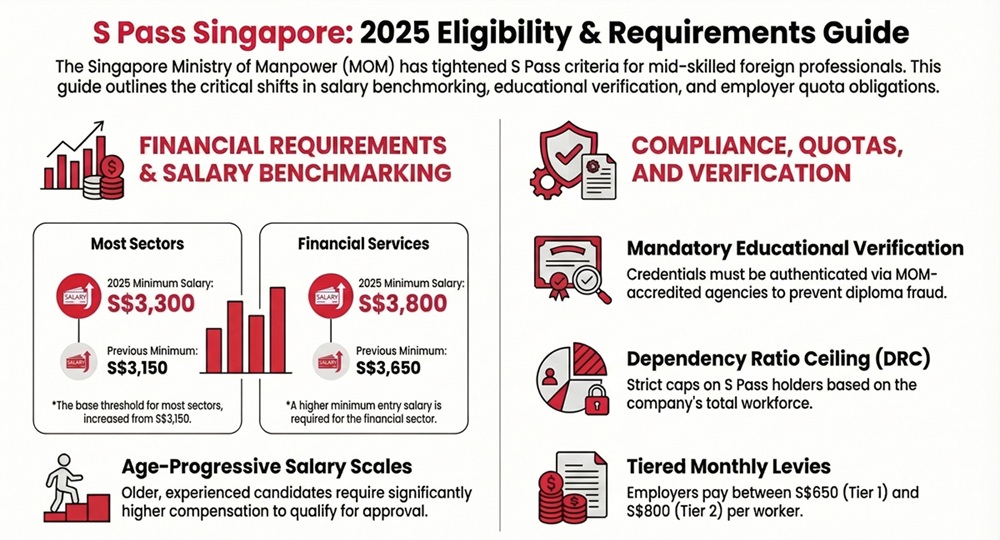
Current minimum thresholds: – S$3,300 monthly for most sectors (increased from S$3,150) – S$3,800 monthly for financial services sector (increased from S$3,650).
However, these figures represent only the starting point. The S Pass requirement includes age-progressive salary scales, meaning older, more experienced candidates need substantially higher compensation. A 40-year-old technician might require S$4,200 or more to qualify, depending on their sector and experience level.
| Requirement Category | Details |
|---|---|
| Minimum salary (most sectors) | S$3,300 monthly |
| Minimum salary (financial services sector) | S$3,800 monthly |
| Age-progressive salary scale | Older and more experienced candidates require higher salaries based on experience and sector. |
| Tier 1 levy (higher-skilled workers) | S$650 per month for most sectors |
| Tier 2 levy (basic-skilled workers) | S$800 per month for most sectors |
| Construction sector levy | Different levy rates apply depending on the specific construction sub-sector |
How salary benchmarking works
MOM uses Singapore’s local wage data to determine minimum S Pass salaries. Employers must submit competitive, realistic salaries that match job responsibilities and the applicant’s experience.
Sector quotas & levy requirements
Beyond individual eligibility, employers must also navigate complex quota systems and levy structures that significantly impact hiring strategies and costs. These constraints often catch first-time employers off guard, making advance planning essential for successful S Pass applications.
Dependency ratio ceiling (DRC) – the quota reality
Each company faces strict limits on S Pass holders based on their total workforce and industry sector. Different industries have different caps, for example:
- Manufacturing
- Services
- Process
- Construction
- Marine
If your company has already reached its quota, new S Pass applications will be automatically rejected regardless of candidate quality. We’ve seen employers spend months on recruitment only to discover that they lack quota space. Being equipped with the right information ahead of time will help you avoid this situation.
S Pass levy
S Pass employers must budget for monthly levies that vary by tier and sector:
- Tier 1 (higher-skilled): S$650 per month for most sectors
- Tier 2 (basic-skilled): S$800 per month for most sectors
- Construction sector: Different rates apply based on specific sub-sectors
These levies continue for the entire employment period and significantly impact total employment costs. A company employing five S Pass holders might face S$3,250 in monthly levies alone, making workforce planning crucial for budget management.
Qualification Requirements
S Pass qualification requirements have become increasingly stringent, with MOM now requiring comprehensive verification of a candidate’s educational credentials. Understanding these standards early prevents costly delays and rejections during the application process, ultimately helping you source the right talent for the role.
Essential qualification criteria: Most S Pass applicants need a recognised diploma, technical certification, or vocational qualification directly relevant to their intended role. Unlike Employment Pass applications, S Pass focuses on practical competence and industry-specific skills rather than purely academic achievements.
Critical verification standards: All educational documents must be authentic, issued by legitimate institutions, and verifiable through official channels. MOM has significantly enhanced its scrutiny of educational qualifications; particularly from institutions in countries with known document fraud issues. For qualifications from unfamiliar institutions, employers may need to provide additional verification through MOM-accredited agencies. This process can take several weeks, so early preparation is essential for time-sensitive hiring. Be sure to plan ahead and be mindful of extended wait times.
Industry-specific requirements: Certain sectors have additional qualification mandates. Healthcare roles require professional registration, construction positions need safety certifications, and marine roles often demand specific maritime qualifications. These sector-specific requirements are non-negotiable and must be satisfied before application submission.
Experience & Job Matching
MOM conducts thorough assessments to ensure S Pass applications represent genuine skill requirements rather than attempts to circumvent higher-tier pass requirements or access cheaper labour. The experience and job matching evaluation has become particularly rigorous in Singapore.
Key evaluation areas:
The job scope must clearly match the applicant’s demonstrated skills and experience level. For example, a quality control supervisor position should align with previous supervisory experience in manufacturing or related fields. MOM looks for logical career progression that supports the claimed level of expertise for the candidate.
Role classification must accurately reflect the work’s technical complexity. A position requiring S Pass-level skills should involve technical decision-making, supervision of others, or specialised knowledge that justifies mid-skilled classification. Basic operational tasks typically warrant Work Permit classification instead.
Additional Eligibility Checks
Beyond individual candidate assessment, MOM evaluates the employer’s overall profile and compliance history. MOM also considers:
- company track record
- local hiring support
- company size and business activity
- history of compliance
- reasonableness of the job offer
This holistic assessment determines whether the foreign hire is appropriate and a good fit for the business.
Common Reasons S Pass Applications Are Rejected
After handling numerous S Pass applications at RMI, we’ve identified consistent patterns in rejections that often surprise both employers and candidates. Understanding these common pitfalls can save significant time and resources during the application process.
| Rejection Reason | Explanation |
|---|---|
| Salary does not meet age requirements | Older or more experienced candidates require higher salary offers to qualify. |
| Educational documents cannot be verified | Unrecognised institutions or unverifiable diplomas trigger additional scrutiny. |
| Job scope does not match candidate experience | A mismatch between job responsibilities and the applicant’s background can lead to rejection. |
| Employer quota has been exceeded | Companies cannot hire additional S Pass holders if their quota limit has been reached. |
| Poor employer compliance history | Companies with past regulatory violations face stricter evaluation during application review. |
How Employers Can Strengthen S Pass Applications
Successful S Pass application strategies require thorough preparation and attention to detail. Based on our experience with hundreds of applications, these approaches significantly improve approval rates while reducing processing delays.
1. Use MOM’s Self-Assessment Tool (SAT) strategically
Before investing time in candidate recruitment, verify that both salary levels and skill requirements meet current MOM standards. The SAT helps identify potential issues early in the process.
2. Implement early qualification verification
Start document verification immediately after candidate selection. This prevents last-minute delays caused by authentication issues and demonstrates due diligence to MOM reviewers.
3. Develop comprehensive job descriptions
Create detailed role descriptions that clearly articulate the technical skills required, supervisory responsibilities involved, and how the position contributes to business operations. Vague or generic descriptions often trigger additional scrutiny.
4. Document local recruitment efforts
Maintain records of attempts to hire locally before pursuing S Pass candidates. While not always required, this documentation supports the legitimate need for foreign expertise.
5. Plan quota and levy management
Review current quota utilisation and budget for ongoing levy obligations before making job offers. Understanding these constraints prevents complications during the final approval stages.
6. Strategic timing considerations
Submit applications well in advance of required start dates; particularly for candidates from countries where document verification takes longer. Rushed applications face higher rejection rates due to incomplete preparation.
With S Pass applications becoming increasingly in demand in Singapore, RMI is here to help. Contact us for further guidance and support with the latest S Pass requirements and to apply for thorough background checks. We can help you get ahead with timely and comprehensive screening for foreign hires.
FAQs
What is the S Pass in Singapore?
The S Pass is a mid-skilled work pass designed for foreign professionals working in technical, operational, or supervisory roles in Singapore. It sits between the Work Permit for basic-skilled workers and the Employment Pass for higher-level professionals.
Do older candidates need higher salaries to qualify for an S Pass?
Yes. The S Pass framework uses age-progressive salary benchmarks, meaning older and more experienced candidates must receive higher salary offers compared with younger applicants performing similar roles.
What qualifications are required for an S Pass?
Most S Pass applicants need a recognised diploma, technical certification, or vocational qualification that is relevant to the role. Educational documents must be authentic and verifiable through official channels.
Why are S Pass applications sometimes rejected?
Applications are commonly rejected when the offered salary does not meet eligibility thresholds, educational documents cannot be verified, the job scope does not match the candidate’s experience, the employer’s quota has been exceeded, or the company has a poor compliance history.