

Did you know that diploma fraud is a significant and ongoing issue in Singapore? In fact, diploma fraud is so prevalent that it has led to strict legal penalties for offenders across the country.
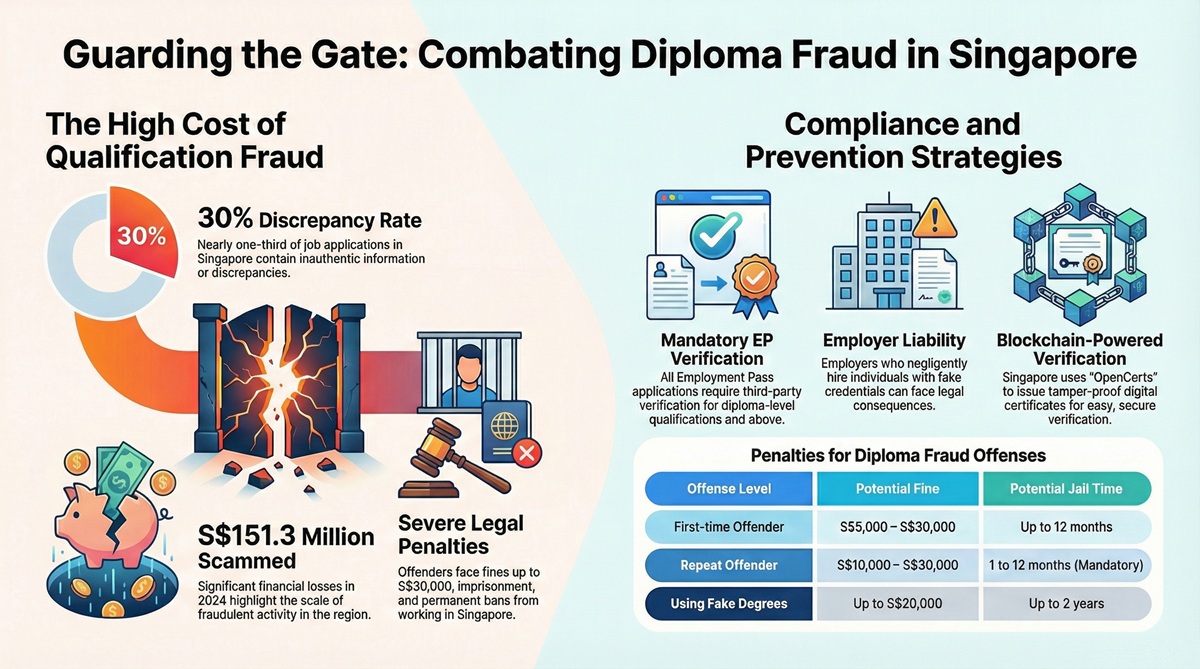
In 2018, nearly 30% of job applications in Singapore were found to contain inauthentic information or discrepancies. Research conducted by First Advantage found that discrepancies are so rife in employment applications in Singapore that it has the highest rates of diploma fraud in the Asia-Pacific region. Employment history (including dates, roles, responsibilities, etc.) and educational qualifications are among the most frequently misrepresented categories in job applications.
Singapore’s Ministry of Manpower (MOM) takes the safeguarding and strengthening of workplace integrity and qualifications very seriously. For this reason, in September 2023, the Singaporean government introduced mandatory verification requirements for certain work passes to combat the rise of diploma fraud.
The MOM regularly reviews and strengthens existing background screening measures for workers to verify the education qualifications of Singapore work pass applicants. MOM has several partnerships with verification background screening providers to ensure candidates submit verification proof of qualifications in support of their work pass applications.
Diploma Fraud in Singapore is Getting Worse (And Costlier)
In 2024, at least S$151.3 million was lost to scammers in Singapore. As a type of scam, diploma fraud is considered a costly and serious criminal offense with legal penalties. Regardless of a candidate’s nationality and background, using fake or forged educational qualifications in Singapore – particularly for employment or immigration purposes – is strictly illegal.
In recent years, MOM has prosecuted individuals, both local and foreign, due to diploma fraud. In fact, in 2021, two Indian nationals were imprisoned for up to four weeks when they were found to have submitted false qualifications to the MOM in their work pass applications. Their work passes have been revoked, and they cannot work in Singapore again.
Offenders of diploma fraud can face a fine of up to S$20,000, imprisonment for up to two years – or even both, under the Employment of Foreign Manpower Act (EFMA). Like the two people imprisoned in 2021, foreigners found to have submitted fraudulent qualifications will have their work passes immediately revoked and will be permanently barred from employment in Singapore.
Consequences and Legal Action of Diploma Fraud:
- Offences: Submitting fraudulent documents for work passes (EP, S Pass, Work Permit) is considered a criminal act, often prosecuted by the MOM and Singapore Police Force.
- Penalties: First-time offenders can be fined S$5,000–$30,000, imprisoned for up to 12 months, or potentially both.
- Repeat Offenders: Repeat offenders of diploma fraud in Singapore may face mandatory imprisonment of 1 to 12 months, in addition to fines of S$10,000–$30,000.
- Future Employment Ban: Individuals found guilty of diploma fraud will have their work passes revoked and will likely face permanent bans from future employment in Singapore.
- Employer Liability: Employers who fail to exercise due diligence in verifying a potential candidate or worker’s educational qualifications may also face legal penalties.
What Types of Education Fraud Should You Watch For?
In Singapore, key types of education fraud to watch out for include diploma mills, forged academic credentials, and tuition scams. Unaccredited institutions that seem ‘too good to be true’ and fast-track degrees are likely to be problematic. Phishing scams impersonating government agencies like the MOM to steal personal data may also come up.
To combat diploma fraud, MOM always screens qualifications submitted in support of work pass applications. The screening process occurs via MOM’s database of institutions which is regularly updated through open-source reports and research from third-party screening organisations.
Work pass applications which are of a higher risk of diploma fraud – such as those supported by qualifications from institutions not found in verifiable databases or flagged by data analytics – are required to submit verification proof from a third-party screening organisation. False qualifications will be immediately rejected, as well the candidate’s application.
While the primary responsibility for checking qualifications lies with the employer, those who knowingly or negligently hire individuals with fake credentials may also face legal consequences and penalties. Employers are liable for overlooking fake credentials in background screening processes.
Employers must ensure the authenticity and quality of the academic qualifications of the candidates they wish to hire. Before hiring, it is expected that the employer will have already evaluated the candidate’s and their legitimacy. The evaluation process should include the authenticity and quality of a person’s qualifications, ensuring that they have the right skills and qualification for the position. Most employers take this role seriously as it is in their best interests to recruit genuine, qualified candidates.
How to Spot Fake Diplomas and Degree Mills
In Singapore’s highly competitive market, the rush to source and fill roles with the best talent can foster a culture of exaggerated work experience and fake degrees among job applicants.
In 2023, MOM commenced investigations into 23 foreigners who had declared qualifications from Manav Bharti University (MBU) in their 2021 work pass applications. The investigation occurred after MOM was alerted that the Indian Government was investigating MBU for selling fake degrees. Set up in 2009 in Himachal Pradesh, MBU is a private institution that is accredited by the Indian Government and had issued authentic degrees.
This is just one example of diploma fraud being facilitated by a legitimate foreign institution – and it is not alone.
HR and recruitment leaders must do their due diligence in detecting fake degrees and diploma mills and help to prevent education fraud in Singapore.
Strategies for Identifying Fake Diplomas and Degree Mills:
- Checking Credentials: It is important to check credentials directly with institutions, using OpenCerts for digital verification, and cross-check information for common red flags like missing watermarks, unrealistic completion times, or unrecognised accreditation.
- Effective Background Screening: The effective screening of foreign qualifications through MOM-approved background screening agencies like RMI will help to prevent diploma fraud.
Measures to Combat Diploma Fraud:
- Mandatory Verification for Employment Passes (EP): All EP applications in Singapore require third-party verification proof for diploma-level qualifications and above, as well as evidence of the institution’s accreditation.
- Partnerships with Screening Providers: The MOM collaborates with accredited background screening companies like RMI to facilitate effective education verification.
- Blockchain-Powered Certificates: For Singapore nationals, universities and polytechnics now issue tamper-proof digital certificates to graduates using a national blockchain-powered platform called OpenCerts. This makes local qualifications much easier to verify.
- University Accountability: Institutions like the National University of Singapore (NUS) and Nanyang Technological University (NTU) now have very stringent policies and procedures in place to expel any students found to have gained entry via fraudulent means.
Combat Diploma Fraud With RMI’s Unrivalled Background Screening Services
Employers are encouraged to take proactive measures to protect their business and brand reputation, as well as ensure a transparent and trustworthy job market in Singapore and Asia more broadly.
To adhere with the MOM regulatory requirements, employers must screen qualifications, especially for work passes. MOM checks all applications for authenticity and may require third-party verification for applications considered higher risk.
HR and recruitment leaders are advised by the MOM to use accredited background screening companies to verify a job applicant’s academic credentials. You can also contact educational institutions directly to verify an applicant’s claims and be on the lookout for unaccredited institutions (diploma mills), inconsistencies in resumes, or a lack of technical knowledge during interviews that indicates a mismatch between their resume and actual skillset.
How can RMI help?
The effective pre-screening of candidates with RMI can help HR and recruitment leaders avoid ensure compliance with MOM protocols. Pre-employment screening matters, and RMI has the knowledge and expertise to help you navigate the requirements for your industry.
RMI brings trusted employment and education verification screening services to the Asia-Pacific region and beyond. We deliver fast turnaround times (generally 7–14 days) and unrivalled customer service for businesses across diverse industries.
We are proudly endorsed by the MOM and Early Childhood Development Agency (ECDA), designing tailored screening services that are fast, people-centric, and hassle-free.
Over the years, RMI has successfully conducted 400,000+ background checks, helping 3,273+ companies find the right hires across 76+ countries. Get in touch with RMI today to verify your candidates with ease, transparency, and fast turnaround.